USJ & Nishikujo Vacation Rentals & Whole-House Stays|Two Stops from Universal City, a Town Reborn from Heavy Industry
When you want to reach the theme park first thing in the morning, the closer your base, the better. Nishikujo is an area chosen for USJ thanks to being just two stops from Universal City Station on the JR Yumesaki Line. Yet this district is not a town of theme parks alone. It is land where a waterfront heavy-industry zone, once lined with shipyards and steelworks, was completely transformed, and where a tunnel you cross by walking beneath the riverbed and an old-town shopping street spared from wartime fires still remain today.
The Site Where USJ Stands Was Once a Shipyard and Steelworks
Universal Studios Japan opened on March 31, 2001 (Heisei 13), on a site of roughly 540,000 square meters in Sakurajima, Konohana Ward. Today it is one of the world's leading theme parks, but this land was originally a waterfront heavy-industry zone lined with facilities such as Hitachi Zosen's Sakurajima works and Sumitomo Metal Industries' West Steelworks.
The factory district facing the harbor had run its course, and redeveloping that vast former site into a theme park was a project that symbolized the regeneration of the Osaka Bay Area. Its opening year drew more than 11 million visitors.
This origin story of "a former factory site becoming a town for play" is by no means unique to USJ. The Ajikawa Tunnel introduced next, and Tempozan with its Kaiyukan aquarium, are all part of the history of how this Osaka bayfront has changed from a "working sea" into a "playing sea." On the way back from the theme park, gazing at the factories and cranes still standing on the opposite shore reveals the history of this town.
The JR Yumesaki Line—The Short, Straight Run from Nishikujo to USJ
You reach Universal City Station, the nearest station to USJ, via the JR Yumesaki Line. Its official name is the Sakurajima Line. The nickname "JR Yumesaki Line" was chosen through a public contest in 2001 to mark the opening.
The line runs just 4.1 kilometers over four stations, from Nishikujo to Sakurajima. Leaving Nishikujo, you pass Ajikawaguchi, and the second stop is Universal City. Some trains run through directly from the Osaka Loop Line.
The starting point, Nishikujo, is a transfer station where the JR Osaka Loop Line and the Hanshin Namba Line meet. In other words, staying in Nishikujo gives you a base that opens in three directions: a single ride on the Loop or Hanshin lines to both Kita (Osaka Station) and Minami (Namba), and just two stops to USJ on the Yumesaki Line. It is an area where it's easy to plan a day playing at the theme park, then changing clothes and heading out into the city for dinner.
The Ajikawa Tunnel—Descend by Elevator and Walk Across the Riverbed
Right near Nishikujo is a somewhat unusual "substitute for a bridge." The Ajikawa Tunnel (Ajikawa Suido) is a pedestrian and bicycle tunnel that links Ajikawa in Nishi Ward and Nishikujo in Konohana Ward beneath the bed of the Ajikawa River.
Construction began in 1935 and it was completed in 1944. It was the first tunnel in Japan built by the immersed-tube method—a technique in which a tunnel built on land is sunk and set on the riverbed—and it was the only underwater road tunnel from before the war. The way you cross is distinctive: you take an elevator down to a passage about 14 meters below the river's surface. The passage is about 2 meters wide and 80 meters long. You walk across to the far bank and rise again. Passage is free of charge.
Cars could once be carried across, but the vehicle elevator was discontinued in 1977, and now only pedestrians and cyclists use it. Selected as a Civil Engineering Heritage site by the Japan Society of Civil Engineers, it is a piece of living infrastructure still in use. Rather than crossing a bridge, you pass beneath the river—this experience itself makes for a detour unique to this area.
Kujo—A Kirara-Sparkling Old-Town Shopping Street Spared from Wartime Fires
South of Nishikujo, on the west side of Kujo Station on the Osaka Metro Chuo Line, is the Kirara Kujo Shopping Street. It is a community-rooted shopping street where about 150 shops line an arcade roughly 600 meters long. Major chains are few, and individual shops predominate.
The nickname "Kirara" was decided by public contest and derives from the mineral mica (kirara). Because the Kujo area was spared the wartime fires of the Great Osaka Air Raids, the atmosphere of an old-fashioned downtown still lingers strongly today. It is a shopping street with the scent of daily life, in contrast to the glitter of the theme park.
(*Note: Kujo also has another shopping street on its east side called "Nine Mall Kujo." The Kirara introduced here is on the west side.) Staying in this area, you can move between the extraordinary world of the theme park and the everyday life of the old town, all within a single day.
Tempozan & Osaka Port—The Kaiyukan, the Great Ferris Wheel, and Yumeshima, the Expo Island
On the opposite shore from USJ, in the Osaka Port area, is Tempozan Harbor Village, where a family can spend a whole day. At its heart is Kaiyukan, one of the world's largest aquariums. Rising right beside it is the Tempozan Ferris Wheel, which at its opening in 1997 was the world's largest, standing 112.5 meters tall. From a roughly 15-minute journey through the sky, on a clear day you can look out to the Akashi Kaikyo Bridge, Kansai International Airport, and Mount Rokko.
The name "Tempozan" comes from an artificial hill formed in 1831 (Tempo 2) by piling up earth and sand dredged from the bed of the Ajikawa River. At just 4.53 meters in elevation, it has a second-order triangulation point at its summit. Long cherished as "Japan's lowest mountain," since 2014 Sendai's Hiyoriyama (3 meters) has been counted as the lowest, and Tempozan is now second. Even so, it is a landmark unique to Osaka Port, reachable by a free ferry to the opposite shore.
And a few stops from Osaka Port on the subway Chuo Line lies the artificial island of Yumeshima. It was the site of the 2025 Osaka-Kansai Expo, and since the closing, redevelopment of the grounds is now under way. On the island's north side, construction of an integrated resort (IR) has begun, aiming to open around 2030. To coincide with the Expo, the subway Chuo Line was extended and Yumeshima Station opened. A reclaimed island transforming into its next form through the Expo—this is an area where you can witness the "future" of the Osaka bayfront.
このエリアの見どころ
観光スポット
食べる
買う
温泉
Access
| USJ (Universal City Station) | Two stops from Nishikujo on the JR Yumesaki Line |
|---|---|
| Osaka Station & Umeda | No transfer on the JR Osaka Loop Line |
| Namba | A few stops on the Hanshin Namba Line (direct to Osaka-Namba) |
| Kaiyukan & Tempozan | Toward Osaka Port via Hanshin and subway |
| Kansai Airport | Transfer at Namba or Tennoji |
| Kobe & Sannomiya | Easy access with through service from the Hanshin Namba Line |
Nishikujo is a hub where the JR Osaka Loop Line, JR Yumesaki Line, and Hanshin Namba Line come together. Beyond being close to USJ, you can also reach the Kobe direction in a single ride on the Hanshin Namba Line, so it makes a base for trips that range widely across Osaka and Kobe.
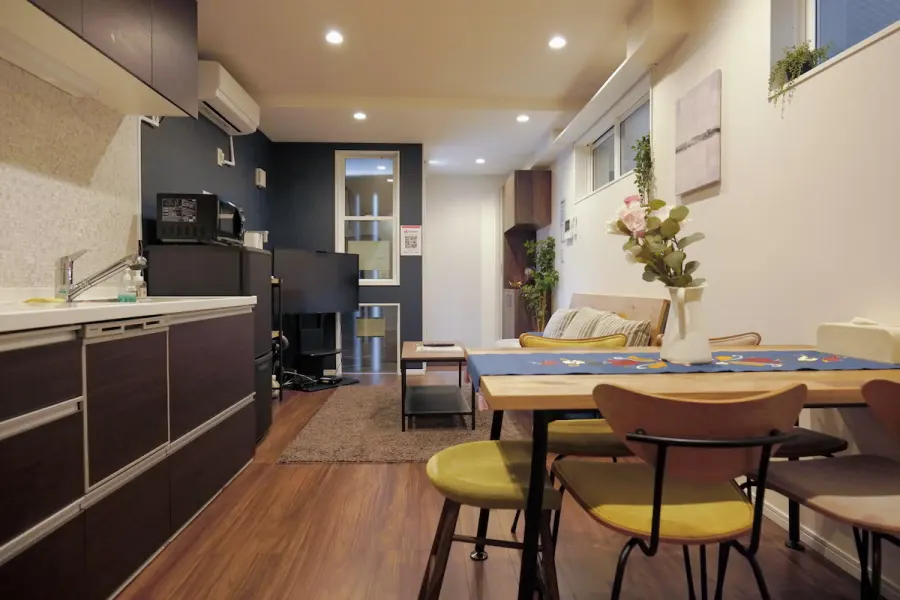
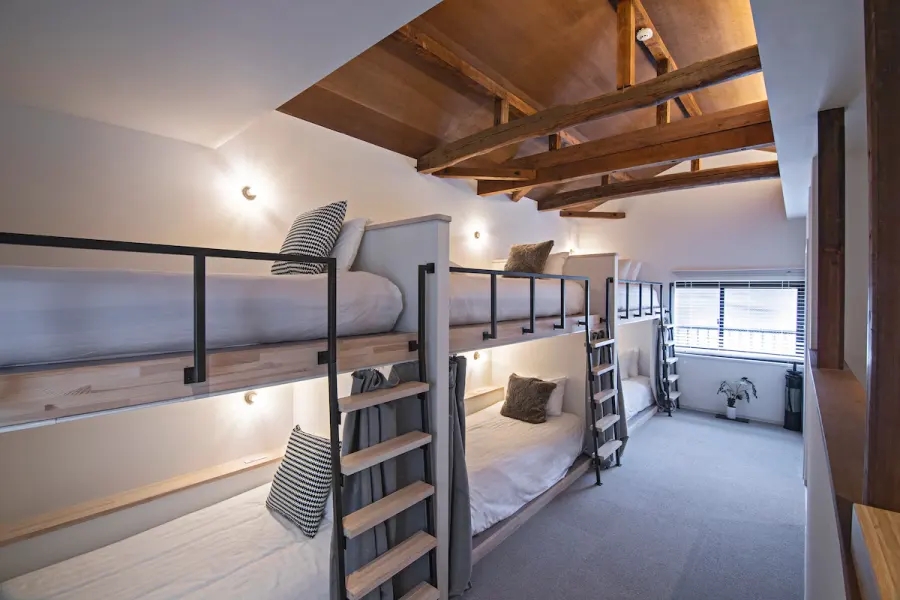
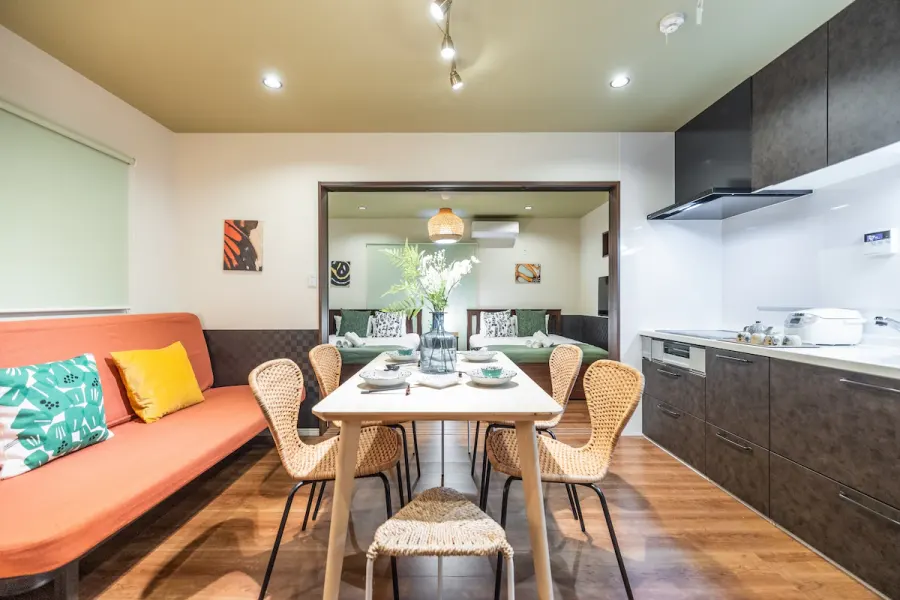
Rooms in This Area
Frequently Asked Questions
- How far is it to USJ?
- Universal City Station, the nearest station to USJ, is two stops from Nishikujo on the JR Yumesaki Line. It is an area suited to those who want to enter the park first thing in the morning. The nearest station and route for each room are listed on their respective pages.
- Are the trains running if I leave early in the morning?
- Both the JR Yumesaki Line and the Osaka Loop Line run from early morning. Because first-train times vary by season and day of the week, please check the latest timetable before you set out.
- Is it fine even with large suitcases or a group?
- This area also has whole-house rooms that can accommodate stays for families and groups. You can search by narrowing down by number of guests.
- Are there places to enjoy nearby besides USJ?
- The Ajikawa Tunnel, where you walk beneath the riverbed, and the old-town Kujo shopping street are close by. It is also an area from which the Tempozan direction, home to the Kaiyukan, is easy to reach by Hanshin and subway.
- Is it easy to get to Umeda or Namba?
- You can reach Osaka Station and Umeda with no transfer on the JR Osaka Loop Line, and the Namba direction via the Hanshin Namba Line.
- Can I also go toward Kobe?
- From Nishikujo, the Hanshin Namba Line runs through directly toward Kobe and Sannomiya. It is an area that easily serves as a base for trips combining Osaka and Kobe.
- Is there a kitchen?
- It varies by room. Many whole-house rooms come with a kitchen. Please check the facilities on each room's page.
- Can I store my luggage?
- Handling of luggage before check-in and after check-out varies by room. Please check the guidance we send after your reservation.