Vacation Rentals & Whole Houses in Namba & Dotonbori | Stay in the Home of Kuromon Market and Osaka's Food Culture
Namba, the city where you eat until you drop. The signs of Dotonbori, the arcade of Kuromon Market, the stone-paved lanes of Hozenji Yokocho—everything that says "this is Osaka" is packed within a one-kilometer radius. The biggest advantage of staying in this area is that you can walk home. However late you drink, however much luggage you gather, there's no need to worry about taxis or the last train. Rent a whole house with a kitchen, and Kuromon Market stops being a tourist spot and becomes "the neighborhood market."
Dotonbori—Named After a Single Merchant Who Poured in His Own Fortune
The place name Dotonbori is the name of a canal and also the name of a person. In 1612, Yasui Doton (1533–1615) invested his private fortune to begin digging the Minami-horikawa canal. But Doton never saw it completed—he lost his life in the Summer Siege of Osaka. The work was taken over by his cousin Doboku, and the canal was completed in 1615.
At first it was called "Shinbori" or "Minami-horikawa," but it is said that the lord of Osaka Castle, Matsudaira Tadaaki, mourning Doton's achievement and the fortune he had poured in, took his name and named it "Dotonbori."
In other words, the canal that tourists are photographing today is the trace of what one merchant, 400 years ago, dug in the belief that "this town needs a waterway." Playhouses eventually lined its banks, and the whole history of it becoming the city of eating-until-you-drop was built up upon this canal. When you look up at the signs from a bridge, knowing that the river beneath your feet is that river changes the view just a little.
Kuromon Market—the "Kitchen of Naniwa" Began at a Temple's Black Gate
Kuromon Market began in the late Edo period. Merchants gathered around the black gate of Enmyoji Temple, which stood on this spot, and sold fresh fish brought in from Sakai and Kishu—that was its origin. So at the time it was called "Enmyoji Market," after the temple's name.
That Enmyoji Temple relocated to the present-day Higashisumiyoshi Ward after a fire in the Meiji era. The temple left, but only the memory of the "black gate" (kuromon) that had served as a landmark remained on the land, and from the beginning of the Taisho era it came to be called "Kuromon Market." The temple is no longer there, yet only the name of the gate survived to become the market's name—this is what makes this market interesting.
The road afterward was not smooth either. In the Great Namba Fire of the late Meiji era, and in the Great Osaka Air Raid at the end of the Pacific War, the market burned down twice. Even so, right after the war the Kuromon Market Association (now the Kuromon Market Shopping Street Promotion Association) was formed and rebuilt it, until it came to be called the "Kitchen of Naniwa" and the "Stomach of Osaka."
Today, in an arcade running about 580 meters south from Sennichimae-dori, some 150 shops—fresh fish, meat, produce, prepared dishes, and eateries—stand side by side. It was originally a market where professional cooks came to buy their supplies, and even now the early hours are mainly for wholesale purchasing. The food-stall browsing aimed at tourists gets lively from around midday.
For those staying in a whole-house rental with a kitchen, Kuromon Market becomes not a "tourist spot" but a "place to shop." Buy sashimi or meat and eat it in your room—around the third day, when eating out has continued and you're a little tired, having this option is a big thing. It's a few minutes' walk from Kintetsu Nippombashi Station and Nippombashi Station, and walkable from rooms in this area too.
Hozenji Yokocho—the Moss-Covered Fudo-san and a Single Woman
Turn off the bustle of Sennichimae into a single stone-paved alley and you find Hozenji Yokocho. Hozenji is a temple of the Jodo (Pure Land) sect, and has stood here since Kan'ei 14 (1637). The yokocho (side street) itself began with the stalls that did business with worshippers within the temple grounds.
The famous Mizukake Fudoson is covered head to toe in green moss. It is the result of worshippers continuously splashing it with water as they made their wishes. Yet this very custom of "splashing water" is, within the temple's nearly 400-year history, quite new—it began right after the war. It is said that one day a woman who came to pray scooped up with her hands the water that had been offered and splashed it on the Fudo-san; her earnestness took hold as a custom and became what we see today.
One more thing that spread this yokocho's name is Oda Sakunosuke's novel "Meoto Zenzai" ("Sweet Beans for Two"). Ranked alongside Dazai in the phrase "Dazai in the east, Oda in the west," the author depicted the story of Chocho, a level-headed geisha, and Ryukichi, a timid, pleasure-loving young master. It was made into a film too, and "meoto zenzai" became a specialty symbolizing the yokocho.
It is a quiet, dimly lit alley, completely different from daytime Dotonbori. When your lodging is in this area, you can come back to walk it once more at night, after the crowds have gone. The hours when the color of the moss is lit by streetlamps are when this yokocho is most itself.
The Glico Sign and Ebisubashi—a Runner of Over 80 Years, Reflected in the Dotonbori River
Speaking of Dotonbori, there's the Glico sign, arms raised at the finish line along the river. The first one went up in 1935 (Showa 10), a giant advertising tower 33 meters tall. It has changed form with each era since, and the one glowing now is the sixth generation, updated in 2014. Counting from the first, it's a runner who has kept running in the same spot for over 80 years.
During the war it disappeared for a time to metal requisition, then revived after the war. From neon to LED, the background artwork has shifted too, but the basic form of a "runner with arms raised" has never once changed. For the people of Osaka, when it comes to meeting up, it's first of all beneath this sign.
The place to photograph that Glico head-on is Ebisubashi, the bridge spanning the Dotonbori River, nicknamed "Hikkake-bashi." The bridge is always lively with people shooting the sign and taking commemorative photos. When you stay in this area, you can look up at the Glico from a quiet Ebisubashi late at night or early in the morning, after the crowds have gone. The hours when the light is reflected on the river surface are the most beautiful.
Sennichimae—the Hall of Comedy and the Street of Cooking Tools
There are various theories about the unusual place name "Sennichimae." The leading one is that because Hozenji just to the west long continued the "sennichi nenbutsu" (thousand-day prayer)—a devotion that counts a single visit as a thousand days' worth of merit—it was called "Sennichi-dera," and being in front of its gate, the area became "Sennichimae." Another background is also told: in the early Edo period this area held a large cemetery, execution ground, and crematorium, and prayers were offered to mourn the dead there. From the Meiji era on, the execution ground was abolished and the cemetery moved to Abeno, and the former site eventually became one of Osaka's leading entertainment districts.
The Osaka culture that this entertainment district nurtured is comedy. Yoshimoto Kogyo began in 1912 (Meiji 45). The first step was when the couple Yoshimoto Taizo and Sei bought the "Dai-ni Bungeikan" variety hall in Tenma, Osaka; the company, which began in Osaka, would go on to support the culture of Kansai manzai and comedy (its main office is in this Sennichimae even now). The symbol of that is Namba Grand Kagetsu (NGK) in Sennichimae. Opened in 1987, it is a permanent theater of comedy and farce, called the "Hall of Comedy." A show runs year-round, and you can enjoy the manzai and shin-kigeki you've seen on TV in the atmosphere of the room itself.
There's one more street in Sennichimae not to forget: the Sennichimae Doguyasuji Shopping Street. Around Meiji 15 (1882), tool merchants gathered along the approach road to Shitennoji and Imamiya Ebisu Shrine—that was its start; now, in an arcade about 150 meters long, shops handling commercial cooking equipment, tableware, and signage for eateries stand side by side. It's a street that supports the behind-the-scenes of the "city of eating until you drop," where professional cooks come to buy the tools of their trade. In recent years, shops handling wax food samples, and sample keychains that look just like sushi or vegetables, have become popular travel souvenirs. If you're staying in a whole house with a kitchen, you can do some very Osaka shopping—ingredients at Kuromon Market, tools at Doguyasuji.
Nippombashi (Den Den Town)—From a City of Electronics to a City of Subculture
Spreading east of Namba, along Sakaisuji, is Nippombashi. It is read differently from Tokyo's "Nihonbashi," and locally it's called "Den Den Town" and "Ponbashi." "Den Den" is a nickname taken from "denki" (electricity), decided by public competition in 1978. Once a post-town and district of secondhand bookshops, this area became an electronics quarter after the war when shops selling radio self-assembly parts and tools gathered, and then a town of home-appliance retailers. "Akiba in the east, Ponbashi in the west"—it is ranked alongside Tokyo's Akihabara as one of western Japan's largest electronics quarters.
That Nippombashi, too, has changed its face. Shifting its footing from home appliances to the subculture of anime, games, doujin, and figures, the "Ota Road" (Nippombashi-suji Nishidori Shopping Street) on the west side of Sakaisuji is packed with specialty shops of that kind. Every spring a large-scale street event, the "Nippombashi Street Festa," where cosplayers gather, is held too, and it has become another of the town's faces. From a city of electronics to a city of hobbies—while changing what it deals in with the times, it remains an area that has always been a "place to go looking for the things you love."
このエリアの見どころ
観光スポット
食べる
買う
Access
Kansai Airport
To Namba on the Nankai Main Line. No transfer on the Airport Express
Shin-Osaka (Shinkansen)
No transfer on the Midosuji subway line
Umeda / Osaka Station
A few stops on the Midosuji subway line
USJ
Subway or JR, transferring at Nishikujo
Kyoto
By Kintetsu and subway with a transfer, or by JR from Osaka Station
Nara
Direct from Kintetsu-Namba with no transfer
Namba is a terminal where the Nankai, Kintetsu, Hanshin, and subway lines converge. Since you can reach both Kansai Airport and Nara without a transfer, it's an area that makes an easy base for a trip covering the wider Kansai region.
Many of the rooms in this area are within walking distance of Dotonbori and Ebisubashi. The nearest station and walking time for each room are listed on its page.
What time is best to go to Kuromon Market?
It was originally a market where cooks came to buy supplies, and the early hours are mainly for wholesale purchasing. The food-stall shops open from around midday. Since hours vary by shop, please check the market's official information.
How do I get there from Kansai Airport?
You can come to Namba directly, with no transfer, on the Nankai Main Line Airport Express.
Is there a kitchen?
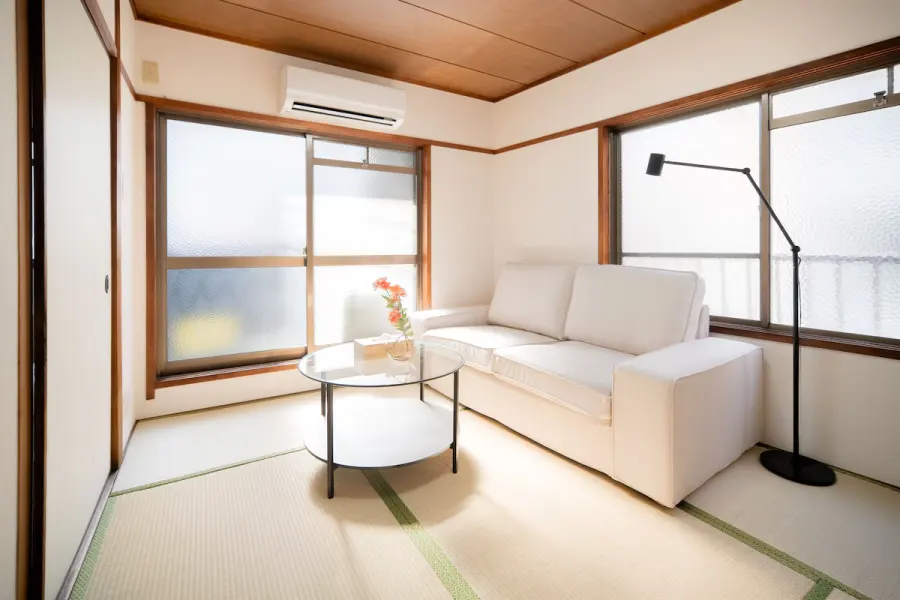
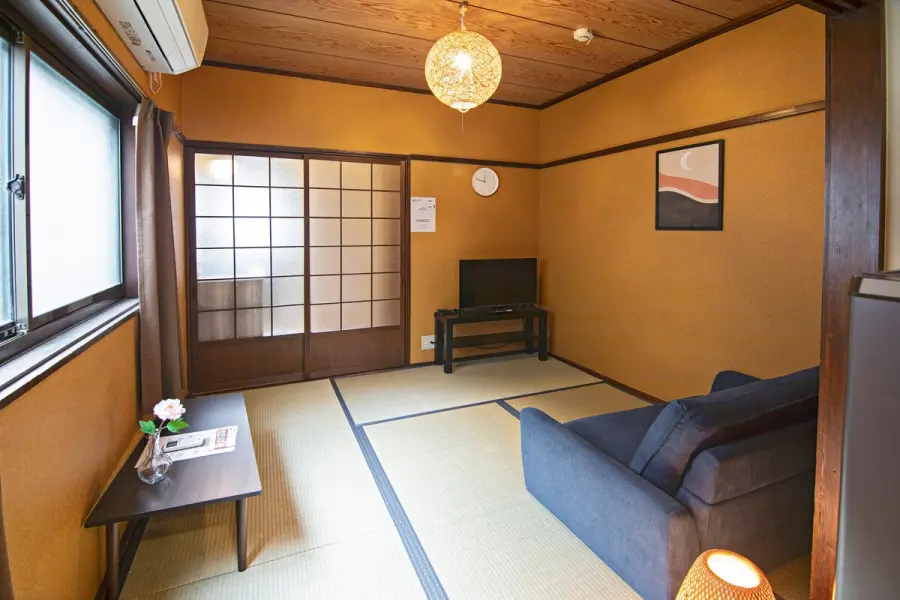
This area is mainly whole-house rentals, and many rooms come with a kitchen. Many guests buy ingredients at Kuromon Market and cook. Please check the facilities on each room's page.
How many people can stay?
It varies by room, but whole-house rentals include rooms that can accommodate a stay for families or groups. You can search by filtering by number of people.
Isn't it noisy at night?
The heart of Dotonbori is lively at night too, but there are also rooms located in the residential streets just one turn off. If you want to spend a quiet time, please choose a room a little away from the entertainment district.
Can I store my luggage?
Handling of luggage before check-in and after check-out varies by room. Please check the information we send after you book.
Are day trips to Nara or Kyoto easy?
You can reach Nara directly from Kintetsu-Namba with no transfer. Kyoto is also within day-trip distance by JR or private railway.