Vacation Rentals & Whole-House Stays near Kyoto Station | Walk from the Shinkansen gateway to To-ji and the Hongan-ji temples
A trip to Kyoto usually begins at Kyoto Station. Whether you arrive by Shinkansen or from Kansai Airport, this is the gateway where you first set foot. The vast station building of glass and steel, the Kyoto Tower standing right in front of it, the five-story pagoda of To-ji just a short walk away, and the eastern and western Hongan-ji temples side by side—the "new Kyoto" and the "thousand-year Kyoto" are packed within a radius of just a few hundred meters around the station. It is an area strong on mobility, a starting point for reaching any sightseeing destination.
The Kyoto Station Building—a glass valley mirroring the city's grid
The current Kyoto Station building is the fourth generation, opened in 1997. It was designed by architect Hiroshi Hara (who also designed the Umeda Sky Building). Chosen through an international competition, its concept was "a scent of culture and a medium of the vibrant city." Incorporating the idea of the jobo system (the grid layout) of Heian-kyo, it is a vast structure of 16 floors above ground and 3 below.
The inside of the station building is like a valley made of glass and steel. The Grand Stairway that rises at its center has 171 steps and a height difference of 35 meters, and at night it is lit up with 15,000 LEDs. The passage that crosses over the roof, the SKYWAY, is 185 meters long and lets you look down into the station's atrium from a height of 45 meters above ground. The Happy Terrace on the roof is a viewing space about 60 meters high.
It is less a "station" than a single three-dimensional town. On the very day you arrive, drop off your luggage and climb to the top of the station building first—you can take in at a glance the lay of the Kyoto you are about to walk.
Kyoto Tower—not a candle, but actually a "lighthouse"
The white tower standing straight in front of the station is Kyoto Tower. It opened in 1964, the year of the Tokyo Olympics. It stands 131 meters tall, with an observation deck 100 meters above the ground.
This tower is often likened to a "candle" and called things like "the candle of O-Higashi-san (Higashi Hongan-ji)," but its official motif is actually a "lighthouse." A lighthouse to illuminate the city of Kyoto, which has no sea. The "candle" is merely a nickname derived from tourist guides. It is also said that the height of 131 meters is a nod to Kyoto City's population of 1.31 million at the time, but this is not a claim with firm backing.
Its structure is unusual too: it uses no steel framing at all and is built with a "monocoque structure" in which the cylindrical outer wall itself supports the tower. At the time of its construction, it was a tower that sparked fierce controversy for and against, on the grounds that it marred the scenery of the ancient capital. Today, as a landmark in front of the station, it lets you know at a glance that you have arrived in Kyoto.
To-ji—home to Japan's tallest wooden tower, a living witness to Heian-kyo
Walking southwest from Kyoto Station, you reach To-ji (Kyoo-gokoku-ji), where a five-story pagoda rises. Built in the 15th year of Enryaku (796) as an official temple to protect Heian-kyo, it is a truly precious place where almost the only surviving temple complex of Heian-kyo remains. In the 14th year of Konin (823), Kukai (Kobo Daishi), to whom Emperor Saga entrusted the temple, made it the head training center of Shingon Esoteric Buddhism.
The symbolic five-story pagoda is about 55 meters tall, the tallest wooden structure in Japan. It burned down four times from lightning strikes and other causes; the one that stands now is the fifth generation, rebuilt in the 21st year of Kan'ei (1644) through a donation by Tokugawa Iemitsu, and designated a National Treasure. Inside the first tier of the pagoda, the central pillar is regarded as Dainichi Nyorai, surrounded by statues of nyorai and bodhisattvas.
The three-dimensional mandala enshrined in the lecture hall is another highlight. It expresses the Esoteric Buddhist worldview by arranging 21 Buddhist statues three-dimensionally, and Kukai's thought rises up before your eyes as an "arrangement of statues." To-ji is one of the World Heritage "Historic Monuments of Ancient Kyoto." Within walking distance of the station lingers the very presence of Heian-kyo itself.
Higashi Hongan-ji & Nishi Hongan-ji—the eastern and western great temples, alike yet different
On the north side of Kyoto Station stand two enormous temples side by side: Higashi Hongan-ji and Nishi Hongan-ji. They are often confused, but their origins and standing differ.
The Hongan-ji, once a single temple, split into east and west in the 7th year of Keicho (1602). When Tokugawa Ieyasu donated land to Kyonyo, it divided into two head temples: the west (Hongan-ji school) and the east (Otani school). Nishi Hongan-ji (formally Ryukokuzan Hongan-ji) is registered as a World Heritage "Historic Monuments of Ancient Kyoto" and holds National Treasures such as the Goei-do, the Amida-do, the Kara-mon, and the Hiun-kaku.
Meanwhile, the Goei-do of Higashi Hongan-ji (formally Shinshu Honbyo) is a world-class wooden structure said to even surpass the Great Buddha Hall of Todai-ji (rebuilt in 1895). However, Higashi Hongan-ji is not a World Heritage site—only Nishi Hongan-ji is registered. This is easy to get wrong, so it is worth noting here. Since both east and west are within walking distance of Kyoto Station, comparing the two great temples reveals well how the character of architecture that branched from the same sect can differ.
Umekoji—a Heian lane's name, now a town of aquarium and railway museum
Walking west from Kyoto Station, you reach an area called Umekoji. The name is old: it is said to have originated in the name "Umekoji," a lane laid out when Emperor Kanmu built Heian-kyo in the Heian period. Spanning more than a thousand years, it lives on today as a place name.
This district became a railway town in the Taisho era. In 1913 (Taisho 2), Umekoji Station, handling freight, was established, and the following year the Umekoji Locomotive Depot was placed here, making it a major hub for steam locomotives. The fan-shaped roundhouse and turntable are still preserved today.
With that railway heritage at its core, Umekoji has now become a town bustling with families. Within Umekoji Park (about 13.7 hectares), opened in 1995, stand the Kyoto Aquarium, opened in 2012, and the Kyoto Railway Museum (one of the largest in Japan), opened in 2016. It is an area within walking distance of Kyoto Station where families with small children can spend a whole day. Here is another face of Kyoto, different from the Kyoto of shrines and temples.
The food of Kyoto—dashi, obanzai, and yuba, a thousand-year taste passed down
Kyoto's appeal is not only its temples, shrines, and gardens. In this city, which continued as the capital for more than a thousand years from the time of Heian-kyo, a distinctive cuisine took root, nurtured by the cultures of court nobles, warriors, and temples. The imperial court's daikyo banquet dishes, the temples' shojin vegetarian cuisine, the kaiseki of the tea ceremony, and the home cooking of the common people—all these layered together to give rise to today's Kyoto cuisine. At its foundation is a delicate seasoning that brings out the natural flavor of ingredients, drawing on dashi stock made from kelp and bonito.
The home-cooking version of that Kyoto cuisine is obanzai. A word born in the Edo period, it uses seasonal Kyoto vegetables and dried foods, finishing dishes—dressed dishes, simmered dishes, deep-fried and marinated dishes—in ways that bring out the flavor of the ingredients. It is the everyday taste of Kyoto, passed from grandmother to mother, from mother to daughter. The Kyoto vegetables themselves are ingredients unique to this land, created by improving vegetables brought from various regions ever since the capital was placed here at the end of the 8th century.
In Kyoto, with its many temples, shojin vegetarian cuisine, which uses no meat or fish, has also taken root as part of the food culture. These are richly flavorful dishes made with seasonal vegetables, tofu, and yuba (tofu skin); yuba is said to have been brought back from the continent along with Zen by monks studying abroad in the late Kamakura period. Yudofu (hot tofu), enjoyed around Nanzen-ji and Arashiyama, is another Kyoto-style dish in that tradition. If you stay in this area, from which every direction is easy to reach from Kyoto Station, you can enjoy these Kyoto tastes between temple and shrine visits.
このエリアの見どころ
観光スポット
食べる
買う
Access
| Shinkansen (Kyoto Station) | The area is Kyoto Station itself. You can drop off your luggage as soon as you arrive. |
|---|---|
| Kansai Airport | Direct by the JR Limited Express Haruka, no transfers |
| Kiyomizu-dera, Gion, Higashiyama | By city bus, or by JR/Keihan toward Higashiyama |
| Arashiyama | Direct to Saga-Arashiyama Station on the JR Sagano Line, no transfers |
| Fushimi Inari, Uji | A few minutes and up on the JR Nara Line |
| Osaka (Umeda, Namba) | Direct on the JR Kyoto Line, no transfers |
Kyoto Station is where the JR lines, the Kintetsu, and the subway converge, and the main city bus routes start here too. With direct connections to Kansai Airport and the Shinkansen, and easy access to any sightseeing spot in the city, it is the area best suited to a stay that spans arrival and departure days when you have a lot of luggage.
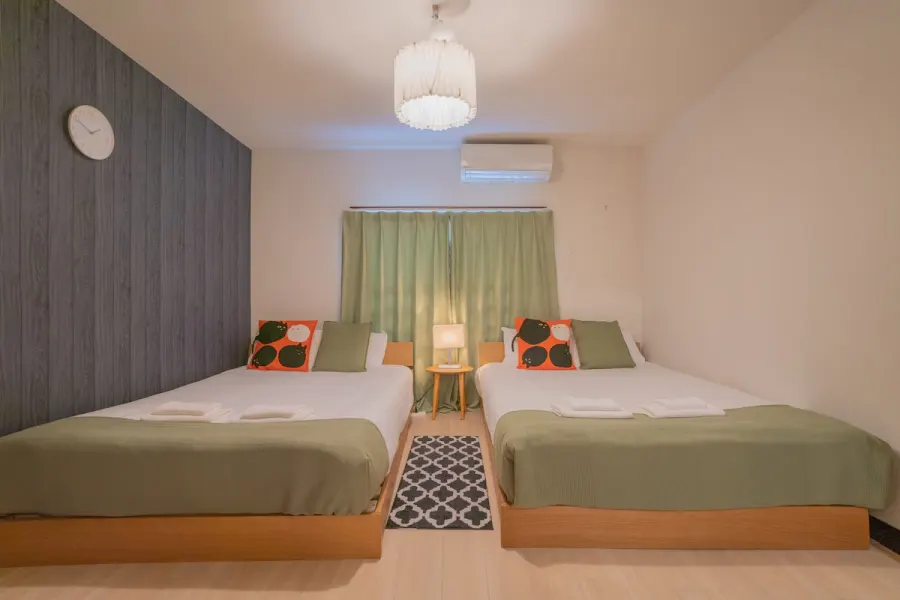
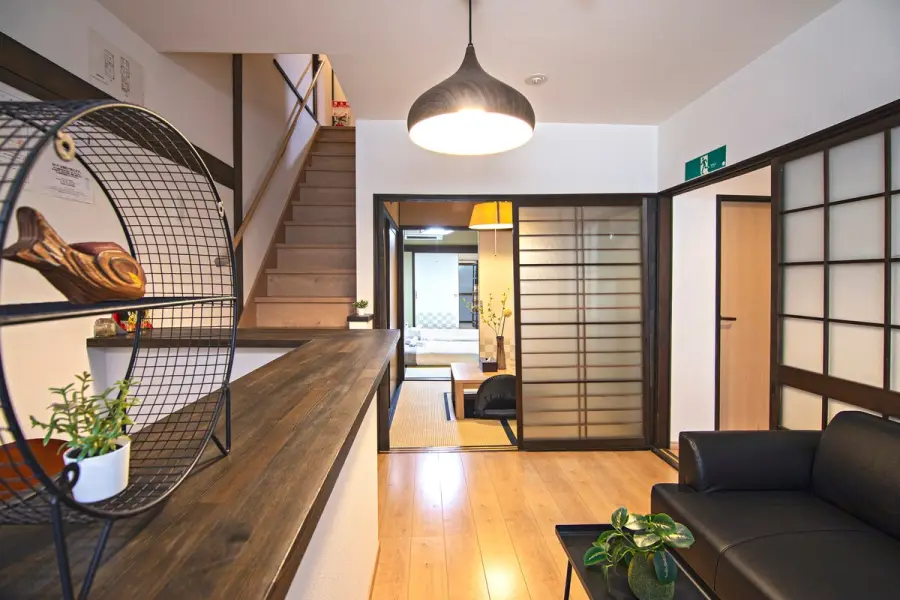
Rooms in this area


Frequently Asked Questions
- Are the rooms close to Kyoto Station?
- The rooms in this area are mainly those whose nearest station is Kyoto Station. It is a location where it is easy to drop off your luggage on the day you arrive from the Shinkansen or the airport. The nearest station and walking time for each room are listed on its individual page.
- How is access from Kansai Airport?
- You can come directly to Kyoto Station on the JR Limited Express Haruka, with no transfers.
- Is it easy to get out to sightseeing spots like Kiyomizu-dera and Arashiyama?
- Kyoto Station is the starting point of the main city bus routes and of the JR and subway lines, and is well positioned for reaching any part of the city. Arashiyama is a direct ride on the JR Sagano Line with no transfers, and the Higashiyama area is accessible by city bus or the Keihan line.
- Can I walk to To-ji and the Hongan-ji temples?
- To-ji, Higashi Hongan-ji, and Nishi Hongan-ji are all within walking distance of Kyoto Station. Please check each temple's official information for opening and visiting hours.
- Is a day trip to Osaka easy?
- It is a direct ride to Osaka Station on the JR Kyoto Line with no transfers. It is an area where it is easy to plan staying in Kyoto and taking a day trip to Osaka.
- How many people can stay?
- It varies by room. You can narrow your search by number of guests. There are also rooms suited to groups and families.
- Is there a kitchen?
- It varies by room. Whole-house rentals include rooms with a kitchen. Please check the facilities on each room's page.
- Can I store my luggage?
- The handling of luggage before check-in and after check-out varies by room. Please check the guidance we send you after your reservation.